


You know that end-of-session feeling. Shoulders up near your ears, lower back staging a quiet protest, and you haven't even moved from your chair in two hours. The usual advice? Get a standing desk. But researchers took a closer look at what actually helps, and there’s an option that is equally as helpful that requires only the measurement of time.
The situation.
Seated job? Check.
Not moving for hours? Check.
Digital productivity? Check.
There have been several studies focusing on interventions for these (and related) characteristics that produced inconsistent results. The study today is focusing on Postural Variability—the transition of the body’s posture. Do these transitions assist the discomfort that researchers have already found in jobs where people are seated for most if not all of their day?
They used 37 participants that worked in a call center that handles regional emergency calls, which is a prime location for this study to occur. As a person who’s worked in a call center before (though definitely not the emergency capacity), the stuck-at-your-desk-all-day struggle is very real. Often, some of my coworkers there would stand while they talked on the phone. The research corroborates this:
Call center operators have also been documented to remain in their seats more than 95% of the work shift (Rocha, Glina, Marinho, & Nakasato, 2005).
They do acknowledge it’s definitely most folks in an office environment though: “The bottom line is that office workers, particularly data entry and call center operators, will work long periods without taking a break.” Considering this group of folks are helping in emergency situations, leaving your desk might be a stress of its own.
There have been studies on achieving sustained neutral postures, but the results have been inconsistent. Some researchers have concluded that neutral joint positioning may be part of a whole solution, but that there’s more to include and consider. And, perhaps unsurprisingly, for those who were experiencing the most discomfort, their productivity suffered. And it looks like there’s a way to keep and maybe improve your productivity from one strategy from this study. More on that in a bit.
At this call center, they tested the following workstation conditions:
1 conventional workstation/existing workstation
2 conventional workstation with reminder software
3 sit-stand workstation
4 sit-stand workstation with reminders.
If you’ve spent a lot of energy customizing your desk setup: split keyboard, tenting kit, chair position, and monitor height… you’re not off track, and there’s more to include in your solution to help discomfort you may be experiencing. More than asking how people sit, this study asked how often they change position.
Relief from Inaction
Our researchers specifically looked at “whether interventions aimed at postural change could encourage adoption of routine dynamic movement of the body.” I personally feel better shifting positions throughout a computer session, but what even counted as posture changes here?
The researchers defined postural changes as large body movements such as:
- Standing up/Sitting down
- Turning away from the workstation
- Walking away from the desk
To go a bit farther with the posture definitions though, the researchers specifically did not count:
- Small arm movements
- Minor shifts in the chair
- Reaching for a phone
Maybe we could bring back that whole Jane Austen thing of “taking a turn about the room”? Understandably, they really needed movements to be easily identifiable in the footage they were taking of their participants.
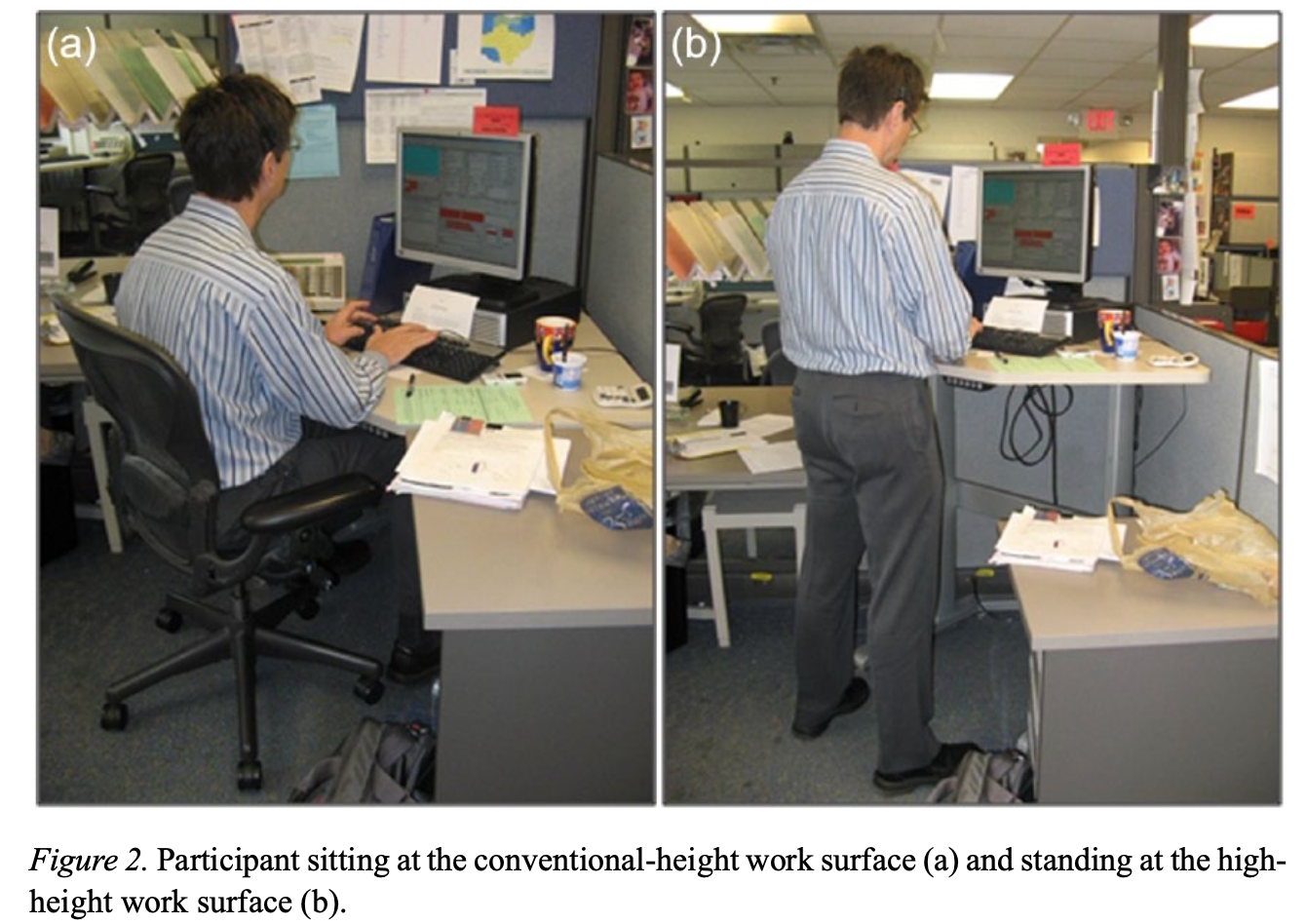
The findings point to positive results, but it’s not a sealed deal that this specific desk is necessary. Although, there could be a future study that focuses primarily on this in particular.
They can be part of a solution, but the standing desks are not quite the entire cake. Another slice of the cake from this study indicates that the reminder software was helpful in reducing body discomfort. The researchers used a reminder software that made meaningful improvements in discomfort levels of participants. Every 30 minutes, the reminder software reminds the participant to shift their posture.
![A screen capture of the reminder software participants saw when it asked them to transition from one posture to another. It features an “ignore” button, a usage tracker and a prompt that reads “Change your posture by either adjusting table height (raise of or lower) or standing and moving around, depending upon your assigned condition. [sic]”](https://storage.ghost.io/c/aa/02/aa02f8d3-418e-41b8-a983-81c666768eb7/content/images/2026/06/data-src-image-5d2dde89-1815-4259-a58b-dee9d9f9f45a.png)
Back to our productivity note
There was a 10% increase in productivity in most cases for the participants that had the adjustable-height table, but the study points out this isn’t noted as significant. At the very least, it seems it didn’t have a detrimental quality to work completion: “It appeared that the postural changes resulted in the worker feeling better without any negative impact on productivity.” You could have a body with less discomfort and the same level of productivity you have now.
The simplest upgrade
The great beauty of this study is that this has immediate things you can do today. From what we’ve covered, the discomfort that people experience in their shoulders, upper back and lower back improved from reminders alone. Your split keyboard is already doing something your old board couldn’t. But it also can’t stand up and stretch for you. Think of a movement reminder the simplest upgrade your setup hasn’t made yet.
Disclaimer: Kayla is not a scientist. She is not wearing a lab coat. As cool as it would be, Keebio is not affiliated with Human Factors.


Member discussion