


Your keyboard is one piece of an entire workstation ecosystem, and every piece can either support your body or quietly work against it. Here's a secret most desk setups don't want you to know: the "standard" chair, keyboard, and monitor arrangement most of us are handed at work wasn't built with your specific body in mind. So if your neck, wrists, or eyes have been quietly filing complaints — that's not you doing something wrong. That's a design gap.
Today we're getting into a study that puts numbers to that gap: a Bangladeshi university surveyed 271 employees and mapped out exactly where their workstations were failing them, body region by body region.
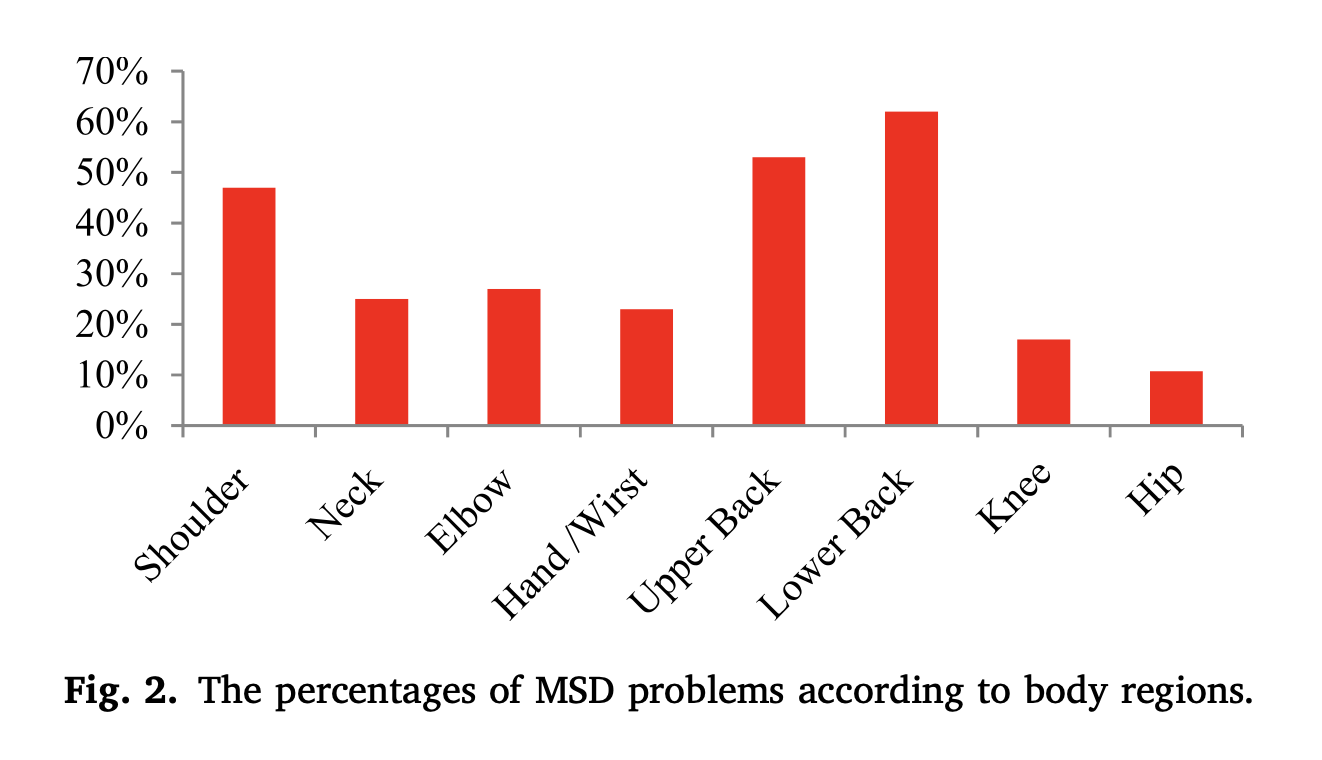
Slow Burn
Most people don't have one ergonomic problem. They have five or six small ones that add up over the course of thousands of hours. One year is 8760 hours. If we're being lenient with ourselves and only considering maybe 40 work hours at a computer every week, that makes 2,080 hours.
Lots of tiny mismatches, and each one nudges the odds of discomfort a little higher.
Assumptions regarding keyboards
Keyboard/input device orientation had a statistically significant link to wrist/hand pain. ...Which is something my wrists have taken to aggressively remind me that not using my split on the couch is something that's problematic over time. The researchers had monitored their participants for 12 months. Look at the table below:
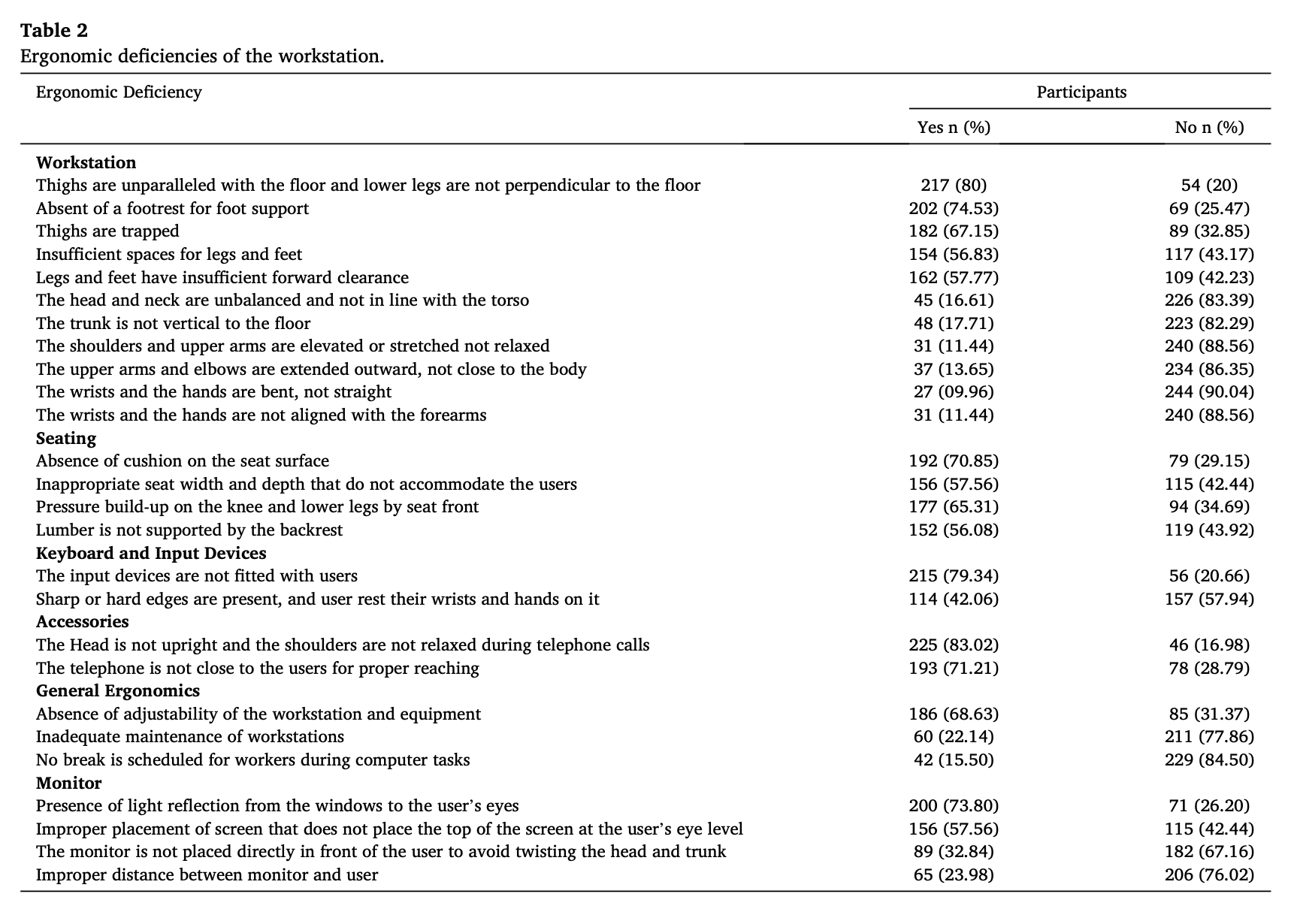
The participants seemed to pick up on the deficiencies in their keyboard pretty easily though: “79.33 % of the participants were unsatisfied with the size and shape of the keyboard…” (pg 6-7).
Only two questions were asked of the participants regarding their keyboard. It’s hard not to read this as a design blind spot.
Unfortunately, no genuine note is made of what type of keyboard is used (unibody vs split) but it seems to underscore the fact that having a keyboard suited to your body is still the critical piece here.
And while there were interesting points in the keyboard data pointing to standard keyboard flaws, there were also a significant amount of people saying their monitor had an ergonomic deficiency.
Eye discomfort
We've been talking about keyboards, but your monitor wants a word too. Glare from a window on a monitor was one of the strongest predictors of discomfort in the entire study. An impressive 73.8% of participants reported this.
As a person who wears glasses, I'd been under the impression for years that having some form of blue-light filtering on my lenses was important, but according to this other study, the results are a bit mixed.
"For... visual fatigue, the lenses offer minor benefits in specific populations, though they appear no more effective than standard lenses for most users. Overall, blue-light-filtering lenses may provide targeted benefits in specific contexts, but their universal effectiveness is inconclusive."
So something to consider about your setup is also the position and brightness of your monitor. The researchers found a statistically significant correlation with reported visual symptoms, and the monitor deficiencies.
Body discomfort
Similar to the discussion in the previous Ergo Life 101 talking about postural variability, this study found that the time seated mattered. The longer a person sat was associated with higher rates of reported discomfort. Which shares a lot with the prickly numbness I get after sitting on my feet like a gremlin…
Turns out there's a few things stacking up here:
- Prolonged static posture
- Long muscle tension
- Insufficient recovery
Holding in place is difficult, and it turns out our body doesn’t seem to enjoy it either. The paper seems to assert that we should reduce sustained awkward positions and not stay there forever.
It all comes together
When we build a keyboard, there are certain pieces that you need that are non-negotiable. Turns out, our workplace ergonomics are a bit similar in this way: we can’t ignore that our desk setup is a full ecosystem determining our comfort (or lack thereof) while we work.
Ergonomics isn't one facet of your desk setup. It's a whole ecosystem, and that can feel like a lot to take in at once.
So here's the good news buried in all this data: participants with better OSHA ergonomic scores had measurably lower odds of MSDs. Small fixes add up just as reliably as small mismatches do. You don't have to overhaul your entire desk this weekend.
Pick one thing from this newsletter: your wrist angle, your monitor height, that glare from the window you've been ignoring — and fix just that one thing this week. That's it.
Because most of the 2,080 hours in a year is a long time to spend fighting gear that was never built for you. Let's make next year's hours a little kinder to your body than this year's were.
Citations
The main paper discussed: Evaluating the ergonomic deficiencies in computer workstations and investigating their correlation with reported musculoskeletal disorders and visual symptoms among computer users in Bangladeshi university from the Department of Industrial Engineering and Management, Khulna University of Engineering & Technology, 2023
Your lenses and blue-light paper: Blue-light-filtering spectacle lenses in managing vision-related symptoms: an updated review from The Adv Ophthalmology, 2026


Member discussion